Washington Oaks State Park | Hidden Gem in Palm
Most people driving A1A through Palm Coast do not know what sits just behind the live oaks lining the road. They see the sign, maybe a glimpse of a garden gate or a parking area, and they keep going — on their way to Flagler Beach or St. Augustine, already running late, convinced that a state park on a weekday morning is something they can do another time. They are missing one of the most genuinely beautiful places in all of Northeast Florida. Washington Oaks Gardens State Park is a Palm Coast hidden gem in the most complete sense of the phrase: extraordinary in what it offers, utterly unknown to the majority of people passing within a few hundred feet of it every single day.
Denise Fernandes stopped. She walked the gardens, crossed A1A to the beach, stood on the coquina rock formations with the Atlantic pulling at her feet, and came back with a simple message: if you live anywhere near Palm Coast and you have not been here, you need to go. This is her guide to the park that earns that description without qualification.
TABLE OF CONTENTS:
01 Between Two Worlds — The Park's Extraordinary Setting
02 The Formal Gardens — Twenty Acres of Living Art
03 The Coquina Rock Beach — Florida's Most Unusual Shoreline
01 Between Two Worlds — The Park's Extraordinary Setting
425 acres spanning the Atlantic Ocean and the Matanzas River along A1A
Washington Oaks Gardens State Park occupies 425 acres along one of the most ecologically rich corridors on Florida's east coast — the narrow strip of barrier land between the Atlantic Ocean to the east and the Matanzas River to the west. A1A, the famous coastal highway, bisects the park, with the formal garden estate on the river side and the coquina rock beach on the ocean side. Crossing A1A within the park is crossing between two entirely different natural environments in a matter of thirty seconds — from manicured gardens and tidal marshes to a rugged Atlantic shoreline that looks more like the coast of Maine or the Outer Banks than what most people expect from Florida. That contrast, that range of experience compressed into a single $5 admission, is what makes Washington Oaks so persistently surprising to first-time visitors.
The park's western section, where the gardens are located, borders the scenic tidal marshes of the Matanzas River. The river-side seawall offers fishing access, and a picnic area sits beneath the shade of the ancient oak canopy south of the gardens. Self-guiding trails lead through a maritime hammock of live oaks, hickory trees, and magnolias, transitioning into coastal scrub community as they move toward A1A. The landscape has the layered, shaded character of a place that has been growing undisturbed for a very long time, and walking through it produces the particular kind of quiet that only genuinely mature natural spaces deliver. This is not a manicured park pretending to be nature. It is nature, with a garden at its heart.
02 The Formal Gardens — Twenty Acres of Living Art
Roses, bromeliads, reflection ponds, and a 200-to-300-year-old grand oak at the center
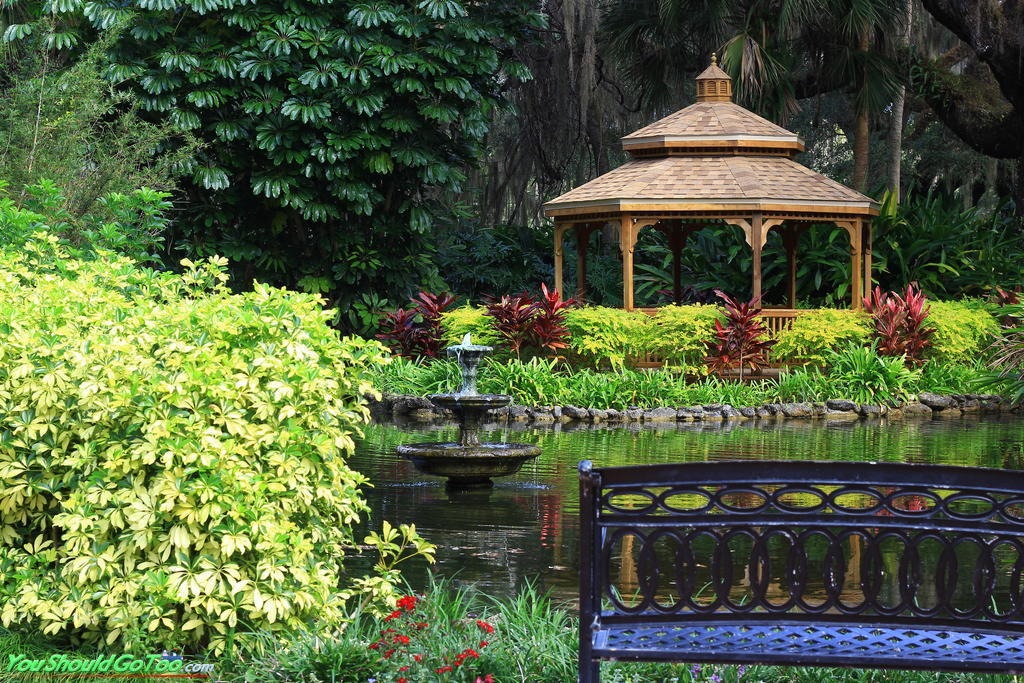
The formal gardens at Washington Oaks are the park's most visited and most photographed feature — and they earn every camera click. Twenty acres of cultivated garden space have been carved from the natural hammock landscape, creating a setting that manages to feel both tended and organic at the same time. The gardens were originally developed by Louise Powis Clark Young, wife of Owen D. Young — chairman of the boards of both General Electric and RCA — who built a winter estate here in 1938. Mrs. Young tended the rose garden, the ornamental ponds, and the tropical plantings for decades, guided by the philosophy that the garden should feel like a natural discovery rather than an imposed design. When she donated the estate to the State of Florida in 1965, she gave the public one of the most beautifully considered small gardens in the southeastern United States.
Walking the brick pathways today, the garden reveals itself in stages: the rose garden in its formal geometric beds, most spectacular in winter and spring when the blooms peak; the winding reflection ponds sheltered by oak canopy; the beds of azaleas, camellias, bird-of-paradise, and exotic bromeliads that give the garden its lush subtropical character; and at the center of it all, the grand Washington Oak — a live oak estimated to be between 200 and 300 years old, its massive horizontal limbs extending over a brick-edged planting bed in a posture that conveys both age and absolute authority over its surroundings. First Friday Garden and History Walks are offered monthly, included with park admission, and provide ranger-guided insight into the garden's history and ecology that adds meaningful context to any visit.
03 The Coquina Rock Beach — Florida's Most Unusual Shoreline
The largest outcropping of coquina rock on the Atlantic coast — tidal pools, photography and a shoreline unlike any other in Florida
Cross A1A from the gardens and the park transforms completely. The ocean side of Washington Oaks features what is widely described as one of the most unusual and photogenic beaches on Florida's entire Atlantic coast: a shoreline of coquina rock formations that emerge from the sand at low tide in dramatic, boulder-strewn configurations that genuinely bear no resemblance to the standard Florida beach experience. Coquina is a sedimentary rock formed from compressed seashells and shell fragments, and this particular outcropping — one of the largest on the Atlantic Ocean — creates a wave-sculpted landscape of tide pools, rounded boulders, and rock platforms that extends along the beach in both directions from the park's ocean parking area.
The coquina formations support a rich intertidal ecosystem. At low tide, the pools trap small fish, crabs, periwinkles, sea urchins, and various species of marine invertebrates that are rarely accessible along Florida's sandy beaches — giving the shoreline an exploratory dimension that makes it a natural destination for families, nature photographers, and anyone who wants to experience something genuinely different from a standard beach visit. The photography opportunities at Washington Oaks are exceptional at any time of day, but golden-hour and blue-hour light on the coquina formations produces images that regularly appear in Florida tourism and nature photography publications. This beach has no parking fee beyond the park's standard vehicle admission.
04 Wildlife, Trails & Annual Events
Birding, fishing, gopher tortoises, and a full calendar of community events throughout the year
Washington Oaks is a productive wildlife observation destination year-round. Gopher tortoises are regularly encountered on the park's trails and open areas — a federally protected species that uses the sandy soil of the coastal scrub habitat for its burrows. Wading birds including great blue herons, snowy egrets, and roseate spoonbills work the tidal marsh edges along the Matanzas River side. Bald eagles and osprey are regular overhead presences. In spring and fall, the park becomes a significant stopover for migratory songbirds moving along the Atlantic Flyway — creating birdwatching conditions that attract experienced birders from across the region during peak migration weeks.
The park hosts a full calendar of community events throughout the year that give regular visitors multiple reasons to return. First Friday Garden and History Walks on the first Friday of every month provide ranger-led garden tours at 10:00 AM. Second Saturday Plant Sales offer Florida-friendly native plants for sale at the park entrance on the second Saturday of each month. Holiday in the Garden is the park's signature seasonal event, transforming the garden for the holiday season. Earth Day celebrations and saltwater fishing clinics round out the annual programming calendar. The park is open every day from 8:00 AM until sundown, 365 days a year. No advance reservations are needed for regular park visits.
Address: 6400 N Ocean Shore Blvd (A1A), Palm Coast, FL 32137
Phone: (386) 446-6780
Website: floridastateparks.org/parks-and-trails/washington-oaks-gardens-state-park
Facebook: facebook.com/washington.oaks
The Hidden Gem That Deserves to Be Found
Washington Oaks Gardens State Park is one of those places that changes slightly how you think about where you live. Flagler County has extraordinary natural assets — this one more than most — and the fact that it sits along a highway thousands of people drive every week without stopping inside is not a reflection of the park's quality. It is simply the nature of hidden gems: they reward the people who stop. Stop. Walk the gardens. Cross A1A. Stand on the coquina rocks with the Atlantic in front of you. This is what Flagler County looks like when it is being completely honest about how beautiful it is.